
Movement Is Learning: 10 Playful Activities That Support Your Child's Development
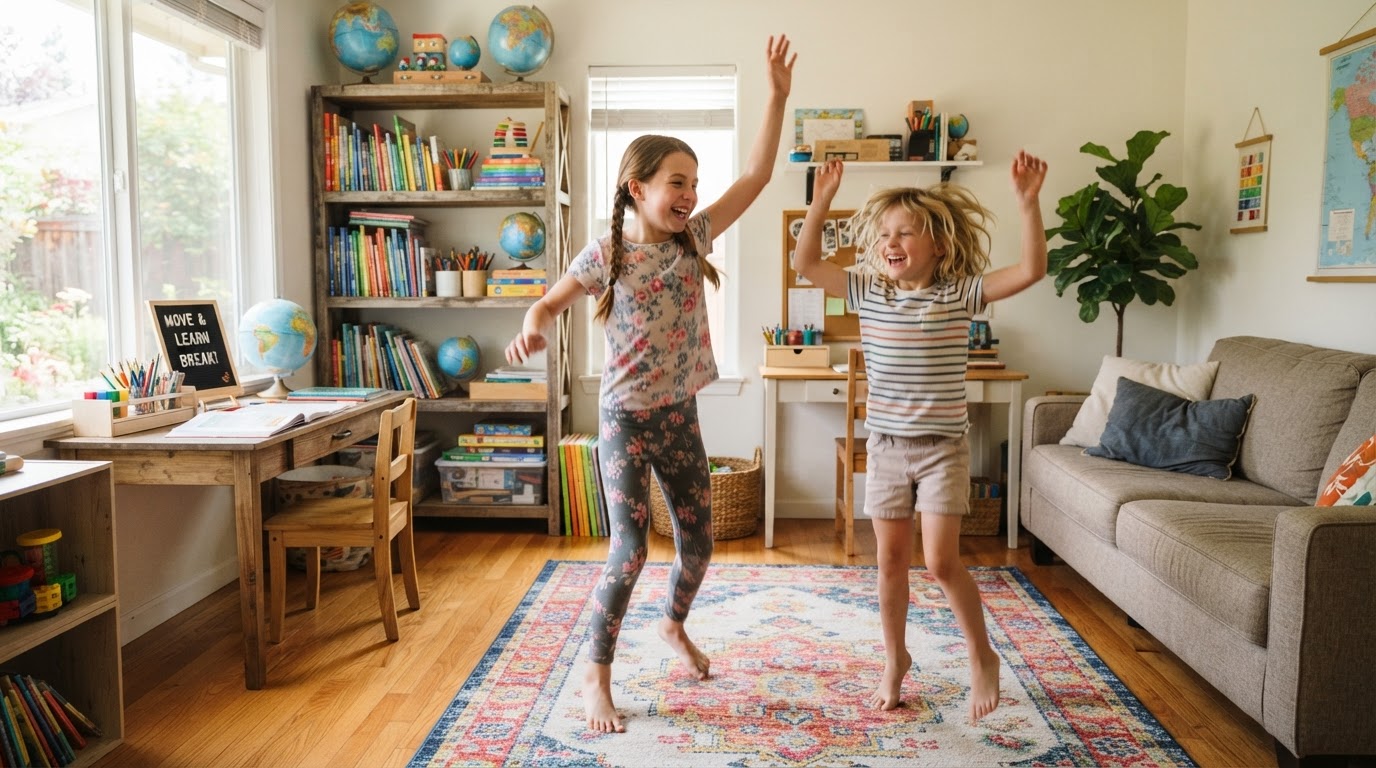
How physical play helps children develop coordination, memory, problem-solving skills, and confidence. Discover why movement is an essential part of how children learn.
Watch young children at play and you'll see them running, climbing, balancing, dancing, building, and experimenting with what their bodies can do.
To an adult, it may look like they're simply having fun. But there's often a great deal of learning taking place.
We sometimes separate physical activity from education. Reading, writing, and mathematics are considered learning, while movement is something children do during a break or after their lessons are finished.
But movement can be an important part of learning itself.
Children use their bodies to explore their surroundings, discover relationships, test ideas, and solve problems. Through physical experiences, they develop skills that contribute to their growing independence and ability to understand the world.
And perhaps most importantly, children don't need every moment of play turned into a lesson to benefit from it.
Why Movement Matters for Children's Development
Physical activity contributes to much more than strong muscles and healthy bodies. It provides children with opportunities to develop coordination, body awareness, memory, planning, and problem-solving abilities.
Consider children creating their own obstacle course. They decide where objects should go, estimate distances, figure out how to move around obstacles, and make adjustments when something doesn't work.
If several children are involved, they may also need to explain their ideas, listen to one another, negotiate rules, and work through disagreements.
All of this can happen during an activity they invented simply because it looked like fun.
Movement and the Developing Brain
When children move, they're doing much more than exercising their muscles. Their brains are busy helping them understand where their bodies are, how to coordinate their movements, and how to respond to what's happening around them.
Think about a young child learning to catch a ball.
The child watches the ball, judges where it is going, moves into position, and reaches out to catch it. At first, these movements may be awkward. With experience, the child becomes better at coordinating what the eyes see with what the hands and body do.
Or imagine a child climbing over a log. How high should I lift my foot? Where should I place it? Can I keep my balance?
These are physical challenges, but they also involve observation, judgment, and problem-solving.
As children grow, their brains continue developing through a combination of natural growth and everyday experiences. Opportunities to move, explore, and play give them practice coordinating their bodies while using important thinking skills.
Physical activity also has benefits beyond coordination. According to the Centers for Disease Control and Prevention (CDC), regular physical activity can help improve children's attention and memory, along with supporting their physical health.
CDC: Health Benefits of Physical Activity for Children — https://www.cdc.gov/physical-activity-basics/health-benefits/children.html
Gross Motor Skills: Building Coordination and Confidence
Gross motor skills involve the larger muscles used for walking, running, jumping, climbing, balancing, and coordinating whole-body movements.
As children gain experience with these activities, they develop greater control over their movements and become more aware of what their bodies can do.
But gross motor activities can also involve thinking.
Imagine a child trying to jump across a small stream. The child must judge the distance, consider where to land, and decide whether the jump is possible. If it seems too far, the child may look for another way across.
That's problem-solving through physical experience.
Activities such as climbing, dancing, building obstacle courses, and playing outdoor games offer children opportunities to develop physical skills while making decisions and testing their ideas.
Fine Motor Skills: Developing Precision and Control
Fine motor skills involve smaller, more precise movements, especially those of the hands and fingers.
Children develop these abilities through activities such as building with blocks, drawing, cutting, threading beads, manipulating small objects, and working with clay.
These skills are important for everyday tasks, including fastening clothing, using utensils, and eventually handwriting.
However, fine motor development doesn't have to begin with pencil-and-paper exercises.
A child constructing a miniature village, creating puppets, or making objects from clay may be practicing hand control and coordination while concentrating on something personally meaningful.
Gross and fine motor skills involve different but sometimes overlapping abilities. Children benefit from opportunities to explore both large movements and activities requiring more precise control.
How Play Supports Memory and Thinking
Have you ever watched children invent a game and then try to remember all the rules they've created?
They may have to remember whose turn comes next, what each player is supposed to do, and how the rules change as the game progresses.
Or consider a child learning a dance. Remembering a sequence of movements, following a rhythm, and making changes when something doesn't work all involve thinking as well as movement.
These experiences give children opportunities to practice remembering information, paying attention, planning ahead, and changing their approach when necessary.
Researchers often refer to these abilities as executive function skills. In everyday language, they're the skills that help us organize our thoughts, make decisions, manage our actions, and work through problems.
Harvard University's Center on the Developing Child explains that children can practice these abilities through games, play, and interactions with others. Its activity guide includes examples for different ages, from infancy through adolescence.
Harvard Center on the Developing Child: Activities Guide — https://developingchild.harvard.edu/resources/handouts-tools/activities-guide-enhancing-and-practicing-executive-function-skills/
What I find especially important is that children don't always need an adult directing these experiences.
When children invent their own games, organize activities with friends, or experiment with different ways to accomplish something, they have opportunities to use these thinking skills naturally.
This doesn't mean every movement activity will automatically improve memory or critical thinking. But it reminds us that play can offer meaningful opportunities to practice skills children use throughout their lives.
Movement and Critical Thinking
Critical thinking begins long before children can explain their reasoning in sophisticated language.
A young child deciding how to cross a puddle without getting wet is already considering possibilities.
Should I jump? Walk around it? Find something to step on? What might happen if I try?
Children use similar thinking when they construct obstacle courses, invent movement games, organize pretend adventures, or create dances.
They encounter problems that may have more than one solution. They test possibilities, observe results, and revise their plans.
When adults immediately provide the solution, children may lose an opportunity to investigate for themselves.
Sometimes the most useful thing we can do is ask, "What else could you try?" and give children time to explore.
10 Playful Movement Activities for Homeschool Families
These activities are starting points rather than prescribed lessons. Children can change the rules, combine ideas, or invent entirely new games.
You don't need special equipment or a carefully planned schedule. Many of these activities can be enjoyed indoors or outdoors and adapted for different ages and abilities.
1. Freeze Dance With a Twist
Play music and invite children to move however they wish. When the music stops, everyone freezes.
Children can invent variations. Perhaps they freeze in the shape of an animal, a letter, or something from a story they're enjoying.
Older children might create their own rules or take turns controlling the music.
What children are exploring: Listening, responding to signals, balance, body control, imagination, and self-regulation.
2. Create an Obstacle Course
Use pillows, cushions, tape, or other safe household materials to create a pathway.
Rather than designing the entire course yourself, invite children to plan it. They might crawl under a table, follow a winding path, step between markers, or balance along a line on the floor.
Encourage experimentation. What happens if they change the order? Can they create a course for someone younger? How might they make it easier or more challenging?
Planning and revising the course can be just as interesting as completing it.
What children are exploring: Gross motor coordination, spatial awareness, planning, estimating distances, problem-solving, and flexible thinking.
3. Invent a Dance
Invite children to choose music and create their own movements.
They might combine four movements into a short sequence, repeat a pattern, or invent something entirely spontaneous.
Children who enjoy structure may want to count beats or organize a longer routine. Others may prefer to move freely without following a particular pattern.
If several children are participating, they can decide whether to create something together or share their individual ideas.
There is no need for a finished performance. The experience of creating and experimenting is valuable in itself.
What children are exploring: Rhythm, sequencing, memory, creativity, coordination, and self-expression.
4. Mirror, Mirror
Two children face one another. One begins moving slowly while the other tries to mirror the movements. Then they exchange roles.
They can experiment with facial expressions, arm movements, different levels, and changes in speed.
With a group, children might invent more complicated versions or attempt to move together without choosing a leader.
What children are exploring: Observation, visual attention, coordination, body awareness, cooperation, and responding to others.
5. Bring a Story to Life
Choose a familiar story, invent a new one, or let children create characters and situations as they go.
How would a giant move? What might it look like to travel through a jungle, cross a rushing river, or explore another planet?
Children can act out their ideas through movement, sound, and dramatic play.
Stories don't have to follow a predetermined script. One child's suggestion may lead to an entirely new adventure.
When children create stories together, they also have opportunities to exchange ideas, negotiate roles, and develop a shared imaginative world.
What children are exploring: Language, imagination, sequencing, communication, cooperation, and creative problem-solving.
6. Rhythm Repeat
Begin with a simple pattern of claps, taps, or footsteps. Invite children to repeat it or create a response.
They might experiment with fast and slow rhythms, long and short sounds, or combinations of movement and sound.
Children can take turns inventing patterns for others to follow. They may even discover mathematical relationships through repeating sequences.
The activity can become a musical conversation rather than a test of whether someone remembers a pattern correctly.
What children are exploring: Pattern recognition, working memory, sequencing, coordination, and early mathematical thinking.
7. The Choreography Challenge
Invite children to create a movement sequence around a theme.
Perhaps they're exploring the weather, the water cycle, animal movements, or a favorite piece of music.
They can decide which movements best represent their ideas and how to arrange them.
A child interested in science might create movements representing evaporation, condensation, and precipitation. Another might invent a dance about an imaginary creature.
The important part isn't producing a polished routine. It's experimenting with ways to represent ideas through movement.
What children are exploring: Memory, sequencing, creative expression, planning, and connecting movement with academic concepts.
8. The Team Balance Challenge
Give children a cooperative movement problem to solve.
For example, can they move across a designated area while keeping a balloon in the air? Can they create a group shape or move together at the same pace?
Let them develop their own strategies and adjust the challenge to suit everyone's abilities.
Cooperative games provide opportunities to listen to others, contribute ideas, and discover that there may be several ways to solve the same problem.
Participation should be comfortable and accessible for everyone. The activity can be adapted for children with different physical abilities.
What children are exploring: Balance, coordination, cooperation, communication, planning, and collaborative problem-solving.
9. Movement Charades
Invite children to communicate an idea without using words.
They might portray an animal, occupation, emotion, character, or event from a book.
Other children can guess what is being represented, or everyone can add movements to develop the idea further.
This can lead to interesting conversations about how people communicate through gestures, facial expressions, and body language.
Children can also invent their own categories and rules.
What children are exploring: Nonverbal communication, imagination, observation, perspective-taking, and creative thinking.
10. Create a Spotlight Moment
Some children enjoy sharing a dance, movement sequence, or imaginative performance with family members. Others prefer not to perform for an audience.
Offer children the choice.
They might demonstrate something they've invented, teach a movement to someone else, or simply enjoy dancing together without anyone watching.
For children who enjoy performing, the experience may provide opportunities to express themselves and become more comfortable sharing their ideas.
But participation should never depend on being willing to perform. Creative movement is just as meaningful when it remains private or spontaneous.
What children are exploring: Self-expression, creativity, communication, and making independent choices.
The Special Value of Child-Directed Play
There is certainly a place for organized sports, dance lessons, and adult-guided movement activities. But children also need opportunities to direct their own play.
When children invent games together, they must do more than move their bodies.
They decide what the game will be, establish rules, assign roles, consider one another's ideas, and adapt when someone proposes a change.
They may disagree, negotiate, compromise, and discover new ways of working together.
These experiences offer opportunities to develop independence, communication, cooperation, and flexible thinking.
One of the most interesting things about children's play is how it changes when they have the freedom to take the lead.
An adult might introduce an obstacle course, but children may transform it into an imaginary rescue mission. A rhythm game might become a musical performance with homemade instruments. A movement story may evolve into a game that continues for days.
These changes aren't distractions from the original activity. They're children bringing their own ideas, interests, and experiences into what they're doing.
Adults can provide materials, encouragement, and a safe environment without needing to control every decision.
Movement Doesn't Have to Be Scheduled
Some families find short movement breaks helpful, especially when children have been concentrating on a quiet activity. Others naturally incorporate movement throughout their day.
A child might practice spelling while hopping between letter cards, explore measurement while building an obstacle course, or act out a historical event.
Another child may prefer to sit quietly while reading or drawing.
The goal isn't to keep children moving constantly or turn every activity into a lesson.
It's to recognize that learning happens in many ways and that children benefit from opportunities to discover what works for them.
Seeding Curiosity Through Movement and Play
Homeschooling gives families the flexibility to observe their children, follow their interests, and create learning experiences that aren't limited to a desk or textbook.
Sometimes that means introducing an activity. Sometimes it means stepping aside and watching children develop their own.
The next time your child invents a game, builds an obstacle course, dances across the living room, or spends an afternoon exploring outdoors, consider the possibilities unfolding through that experience.
You may discover that some of the richest learning happens when children are simply given the freedom to explore.
Movement isn't time taken away from learning. It can be an essential part of how children learn.
Seeding curiosity, one discovery at a time.
Research and Further Reading
Centers for Disease Control and Prevention (CDC): Health Benefits of Physical Activity for Children — https://www.cdc.gov/physical-activity-basics/health-benefits/children.html
Harvard University, Center on the Developing Child: Activities Guide: Enhancing and Practicing Executive Function Skills — https://developingchild.harvard.edu/resources/handouts-tools/activities-guide-enhancing-and-practicing-executive-function-skills/
Ali Markfeld
Retired Educator & Homeschool Consultant