
5 Movement Games That Build Life Skills During Your Homeschool Day
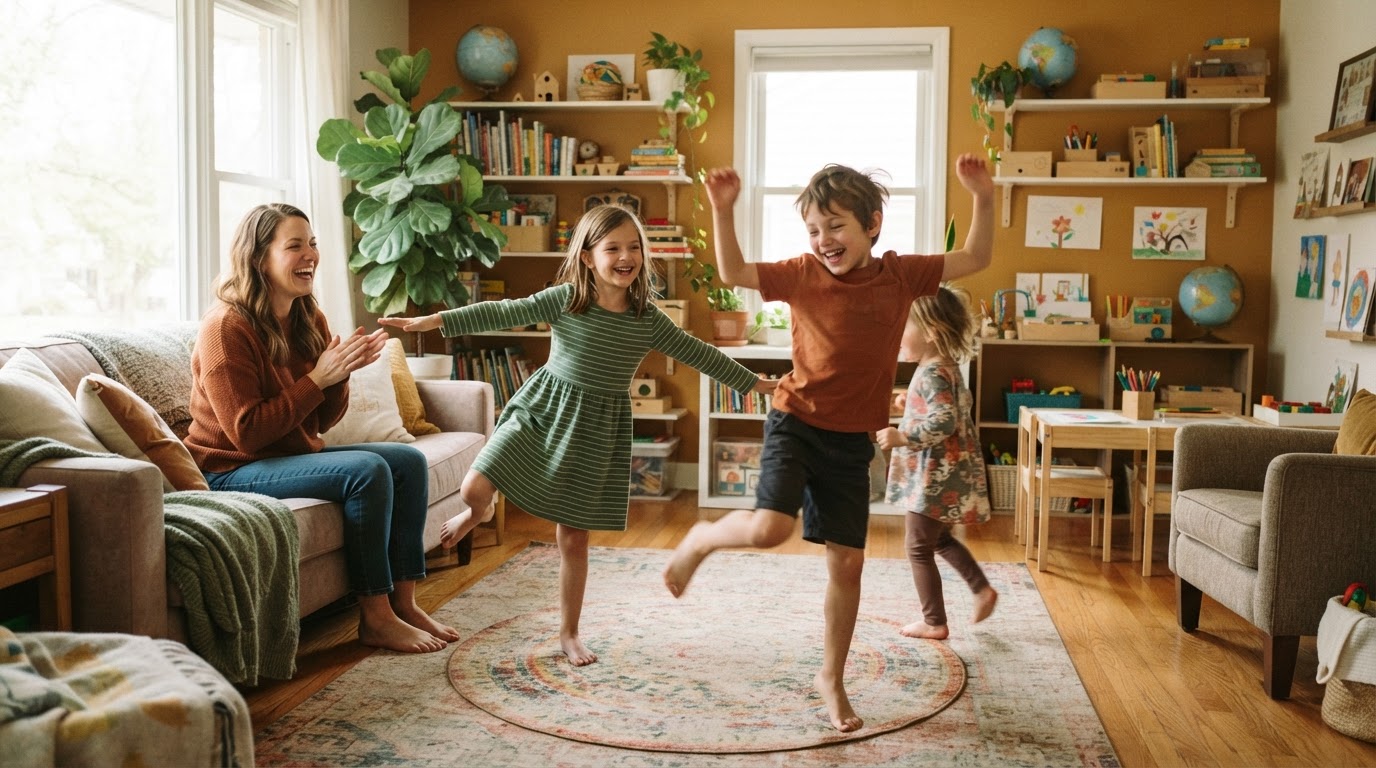
Simple, playful ways to build confidence, resilience, focus, creativity, and memory — without adding another curriculum. A guest post by April Lorenzi, founder of The Secret Dance Technique.
One of the greatest advantages of homeschooling is the freedom to think beyond traditional academics. Math, science, reading, and history matter. But children are also developing the skills they will use across nearly every part of life: confidence, resilience, focus, communication, creativity, and the ability to adapt when something does not go as planned.
The good news? These skills can be practiced — and you do not necessarily need another curriculum to teach them. Sometimes, all you need is a little space to move.
Research on embodied learning suggests that involving the body can make learning more active, engaging, and memorable. Movement also gives children an opportunity to experience concepts instead of simply talking about them. Here are five simple movement activities homeschool families can incorporate into the day. You do not need dance experience, special equipment, or even much space.
1. The Power Character Challenge
Builds: Confidence
Ask your child to imagine the most confident version of themselves. It could be a superhero, performer, athlete, fictional character — or simply a more confident version of them.
Put on a favorite song and ask: How would this character walk into the room? Try walking around with that character's posture, facial expression, and energy. Then experiment with a few movements or a short dance while staying in character.
Afterward, ask: What changed about your posture? Did moving confidently change how you felt? When could you use your "power character" in real life?
The important lesson is that children do not always have to wait until they feel confident before taking action. Sometimes acting confidently first can help the feeling follow.
Homeschool connection: Try this before a presentation, new activity, difficult assignment, co-op meeting, performance, or anything else that makes your child a little nervous.
2. The Impossible Challenge
Builds: Resilience + Growth Mindset
Give your child a movement challenge that is just difficult enough that they probably will not master it immediately. It might be balancing on one leg while completing another movement, learning a short sequence, coordinating two body parts differently, or creating a movement pattern and performing it faster.
The goal is not getting it right immediately. The goal is practicing what happens when something is difficult. Instead of "I can't do it," encourage "I can't do it yet." Then experiment. Can they slow it down? Break it into pieces? Watch someone demonstrate it? Try another strategy?
You can make this even more powerful by learning something new alongside your child. When adults make mistakes, laugh, adjust, and try again, children get to see the learning process happening in real time.
Homeschool connection: The next time your child gets frustrated with math, writing, music, or another subject, ask: What strategy could we change instead of giving up?
3. The Spotlight Focus Game
Builds: Focus + Attention
Tell your child: Don't think about a pink elephant. Not a pink elephant wearing a tutu. And definitely not one dancing through your living room.
Chances are, they are now thinking about a pink elephant. It is a playful way to introduce an important idea: telling ourselves what not to focus on is not always very effective. It can be much more useful to intentionally direct our attention toward something specific.
Turn on music and create an imaginary "spotlight." For the first round, the spotlight might be on the arms. Let the arms lead the movement. Next, move the spotlight to the feet, then the head. You can even try a silly round where one body part is not allowed to move.
Afterward, talk about how changing the spotlight changed their attention.
Homeschool connection: When a school task feels overwhelming, create an academic spotlight. Instead of thinking about the entire worksheet, project, or chapter, ask: What's the one thing we're focusing on right now?
4. The Anything-Is-Possible Game
Builds: Creativity + Flexible Thinking
Give your child an everyday problem: We're stuck in a huge traffic jam. Why? Start with the obvious answers: construction, an accident, rush hour. Then make one rule: There are no wrong answers.
Maybe a family of squirrels is making pancakes in the road. Maybe there is a dinosaur parade. Maybe aliens have landed at the intersection. Try to come up with as many possibilities as you can in one minute. Then choose a favorite and turn it into movement. Your child could create a dance about the dinosaur parade, act out the alien landing, or even turn the entire story into a miniature musical.
This practices divergent thinking — generating multiple possible ideas before narrowing them down.
Homeschool connection: Use the same game before creative writing, art, science projects, problem-solving, or brainstorming. Practice generating lots of possibilities before worrying about finding the "best" one.
5. Move It to Remember It
Builds: Memory + Learning Strategies
Movement does not have to be separate from academics. It can become part of how children learn.
Choose something your child is currently trying to remember: a multiplication fact, vocabulary, a historical date, a science concept, a spelling word, or a foreign-language phrase. Now attach a movement to it. Say a vocabulary word while jumping, create three movements representing the stages of a science process, or build a short movement sequence around facts from a history lesson.
You can also experiment with chunking. Instead of memorizing eight pieces of information individually, divide them into smaller groups and assign each group a movement.
The goal is not simply remembering one fact. It is helping children discover something even more valuable: How do I learn best?
Homeschool connection: Over time, children can begin choosing strategies themselves rather than simply being told to "study harder."
Bonus: The 5-Minute Movement Brain Break
Minute 1: Shake out the entire body.
Minute 2: Move as slowly as possible.
Minute 3: Put on a favorite song and freestyle.
Minute 4: Create four movements and try to remember the sequence.
Minute 5: Take a breath, stretch tall, and choose one thing to focus on when returning to schoolwork.
Movement can be fun without needing to be productive every second. But when we occasionally add intention to it, that same play can become an opportunity to practice skills children can carry far beyond the homeschool day.
Learning Beyond the Textbook
Children are preparing for a world that will require far more than the ability to memorize information. They will need to communicate, adapt, solve unfamiliar problems, work with others, manage challenges, think creatively, and continue learning throughout their lives.
These are not fixed personality traits. They're skills. And skills become stronger through practice.
Homeschool families have a unique opportunity to make that practice active, playful, and part of everyday life. Sometimes that might look like a lesson at the kitchen table. And sometimes it might look like a dancing pink elephant in the living room.
About the Author
April Lorenzi is the founder of The Secret Dance Technique, an online dance education program that combines dance training with intentional development of skills including confidence, resilience, communication, creativity, focus, teamwork, and learning strategies. Her approach draws on her background in psychology, performance psychology, dance, and education to help children build skills they can use both inside and outside the dance classroom.
Learn more: thesecretdancetechnique.com
Further Reading
Mindset: The New Psychology of Success — Carol Dweck
Grit: The Power of Passion and Perseverance — Angela Duckworth
The Alter Ego Effect — Todd Herman
Emotional Intelligence — Daniel Goleman
Tomorrowmind — Gabriella Rosen Kellerman & Martin Seligman
Ali Markfeld
Retired Educator & Homeschool Consultant